Navigating USDA Zones 12 and 13 Across Hawaiʻi Neighborhoods
USDA Zones 12 and 13 can help Hawaiʻi gardeners judge whether a plant is likely to tolerate local winter cold. But a zone label cannot tell you everything about a yard. Elevation, rainfall, wind, sun, and nearby structures all affect growing conditions, so use the map as a starting point—not a planting calendar.
What USDA Zones 12 and 13 Tell You
The USDA Plant Hardiness Zone Map groups areas by their average annual extreme minimum winter temperature. A zone is useful when checking whether a perennial plant, shrub, or fruit tree is likely to survive the coldest conditions typical of a location. It is not a guarantee that a plant will thrive there.
Zones 12 and 13 both describe warm winter conditions, but they are not interchangeable labels. A plant’s hardiness information can help you screen out varieties that are poorly suited to cold exposure. If a plant is rated for a warmer zone than your site, it may be at greater risk during an unusually cold spell. If it is rated for a cooler zone, that indicates cold tolerance—not necessarily good performance in Hawaiʻi’s heat, rain, wind, or soils.
The zone number is best understood as one part of a plant’s growing requirements. For a vegetable garden, it often matters less than the crop’s preferred temperature, moisture, and sunlight. Many vegetables are annuals: they grow, produce, and are harvested within a season. Their success depends on conditions during that growing period, not simply on whether a perennial can survive the local winter.
| What the zone map can help with | What it cannot tell you |
|---|---|
| Whether a perennial plant is likely to tolerate typical winter lows | Whether a plant will handle tropical heat or humidity |
| Comparing general cold exposure between areas | How much rain or wind a particular yard receives |
| Narrowing down plant choices before checking their needs | How much direct sun reaches a bed |
| Identifying places where cold tolerance deserves extra attention | Whether a vegetable is ready to sow at a particular time |
A zone label also does not mean that every yard in the mapped area has the same conditions. A neighborhood can include different elevations, slopes, wind exposure, and drainage patterns. Even neighboring properties may differ: a sheltered courtyard, a sunny hillside, and an open, wind-exposed lot can create distinct growing conditions.
For that reason, treat a zone as a broad cold-tolerance reference. Before buying a plant, check whether its requirements match the actual site. For a broader view of how the labels span the state, see How USDA Hardiness Zones Span the Hawaiian Islands. For an overview of planting beyond the map, Year-Round Planting in Hawaii: How Seasons Differ from the Mainland explains why a mainland calendar may not transfer neatly to an island yard.
Why Hawaiʻi Neighborhood Conditions Differ
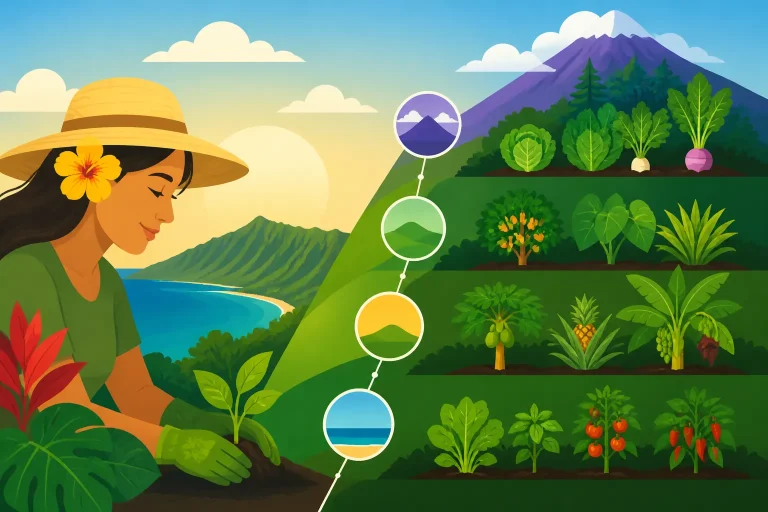
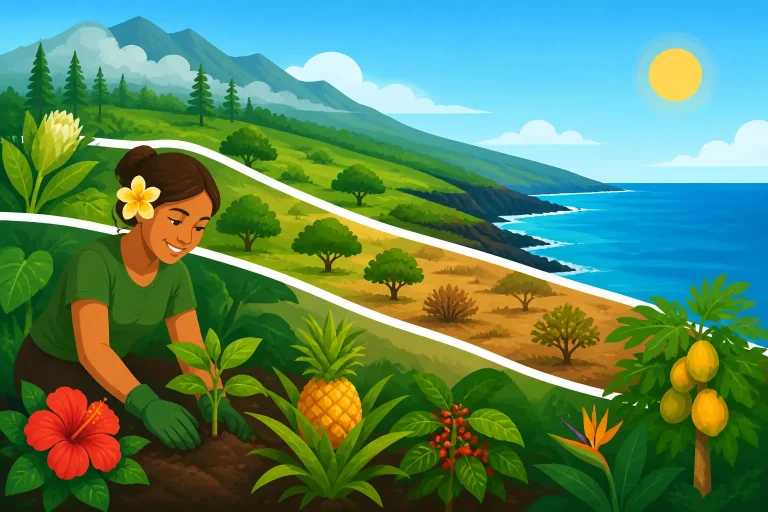
A map can summarize winter cold, but it cannot capture every condition that shapes a garden. Hawaiʻi’s varied elevations, terrain, exposure, and rainfall create differences within and between neighborhoods. That is why two gardens carrying the same zone label may need different plant choices and care.
Elevation and exposure
Elevation can influence temperature and exposure. A garden at a higher elevation may have cooler nights than one at a lower elevation, even if both are in the same general district. Slope and exposure matter too: a site open to wind or weather may behave differently from one sheltered by buildings or vegetation.
The label alone cannot establish the conditions at a particular address. Instead, notice what happens in the yard: Does the site feel cooler at night? Does wind regularly bend or damage plants? Does one section receive full sun while another stays shaded? Those observations help translate a broad map reading into a practical planting choice.
For a closer look at the role of elevation, see How Elevation Shapes Planting Calendars in Hawaiʻi. If your growing area is in an upland setting, Upland and Lowland Planting Windows Across the Islands can help you think about planting windows beyond a hardiness label.
Rainfall and drainage
Rainfall can vary by location and season, and a zone map does not show how wet a garden gets. A bed that stays damp after rain calls for different crop choices and soil management from one that dries quickly. Poor drainage can stress roots even when temperatures are mild. Fast-draining soil, meanwhile, may need more frequent attention to moisture.
Look at the site after rain rather than relying only on a regional description. Note where water collects, how long the soil stays wet, and whether runoff crosses the bed. Raised beds can help in some wet locations, while mulch and irrigation choices matter in drier, exposed areas. The right response depends on the actual soil and drainage; the zone number does not settle it.
The article Managing Wind, Sun, and Rain Across Island Microclimates offers a useful way to assess those interacting conditions. For planting after a particularly wet stretch, How Long to Wait After Heavy Rain Before Sowing Island Crops addresses soil readiness rather than cold tolerance.
Wind, sun, and nearby structures
Trade winds, open ridges, coast-facing yards, and sheltered courtyards can expose plants to very different conditions. Wind can dry foliage and soil, break tender stems, and make a sunny site more stressful. A wall or hedge may reduce exposure, but it can also cast shade or affect airflow. Buildings, fences, and trees change the light a bed receives throughout the day.
Record the hours of direct sun where you plan to plant, and check whether that pattern changes between seasons or as nearby trees grow. A plant that needs full sun may perform poorly in a shaded corner, even if its hardiness range includes the map’s zone. A leafy crop may benefit from partial shade in a hot location. Matching the plant to light and airflow is often more useful than trying to make every part of the yard fit a single zone description.
Use Mapping Microclimates Across Hawaiian Neighborhoods to think through those small-scale differences. For a vegetable-focused overview, Hawaiʻi Home Planting Guide: Seeds, Starters, and Sun Exposure connects site conditions with decisions about seeds and starts.
How to Check a Hawaiʻi Location Without Overreading the Map
The map can be helpful when used at an appropriate scale. Start by looking up the ZIP code or area, then zoom in if the map allows. A ZIP code or neighborhood is a broad search starting point, not a precise description of a garden. A boundary on the map does not account for every slope, elevation change, courtyard, or exposed ridge.
Use the current USDA Plant Hardiness Zone Map when checking a location. Maps can be updated, so avoid relying on an old screenshot or a zone printed on a general-purpose planting chart. If an area sits close to a zone boundary, treat that boundary as a broad transition rather than a sharp line separating two completely different climates.
A careful map check looks like this:
- Look up the ZIP code or general area. Use it to find the broad zone shown for the location, not as proof that every parcel in the ZIP code shares identical conditions.
- Zoom in around the neighborhood. Check whether the displayed zone changes nearby. A boundary close to the garden is a reason to be cautious about treating the label as exact.
- Consider the site’s elevation and exposure. A yard on a slope, in a sheltered pocket, or in an open windy area may differ from the surrounding landscape.
- Compare plant requirements. Read the full plant information, including temperature, sun, moisture, and soil preferences. Do not choose a plant by zone number alone.
- Keep local observations. Note where plants experience wind damage, dry out quickly, or struggle during cooler conditions. Those patterns help refine future choices.
For a step-by-step map lookup, use How to Check Your Hawaiʻi ZIP Code on the Plant Hardiness Map. The map helps answer a specific question about winter cold tolerance; it does not replace observation of the planting site.
Avoid treating zone borders as yard boundaries
A zone map is not a property survey or a yard-level climate reading. Its broad patterns are useful for comparison, but the map should not be used to claim that a specific address has a guaranteed zone or exact temperature. When a plant is marginal for cold tolerance, consider whether the yard is sheltered and whether similar plants have done well nearby. For a long-lived tree or shrub, it is sensible to check more than one source of plant information before planting.
This cautious approach is especially useful when a garden includes several conditions. One bed might be sunny and dry, another shaded and damp, and a third exposed to wind. Assigning a single label to the whole property can hide the very differences that matter most to plant health.
Using Zones Alongside a Hawaiʻi Planting Calendar
A hardiness zone is not a sowing schedule. It does not indicate which month to plant a vegetable, how long a crop takes to mature, or whether the current weather is suitable. Those decisions depend on crop preferences and on the conditions in the bed.
For vegetables, use the zone map mainly as background information. Then choose planting windows based on how a crop responds to heat, rain, and seasonal conditions. Cool-season vegetables may struggle in hot lowland conditions, while a warm-season crop may grow well in a sunny, warm bed but suffer in a wet or windy site. The same crop can need different timing across the islands and across elevations.
A practical planning sequence is:
- Choose the crop for the site. Check its sunlight, moisture, and temperature preferences before settling on a variety.
- Check the planting window. Use a Hawaiʻi-focused calendar rather than assuming mainland months apply. Hawaiʻi Home Garden Calendar: Sowing, Sun, and Seasonal Rains offers a seasonal framework.
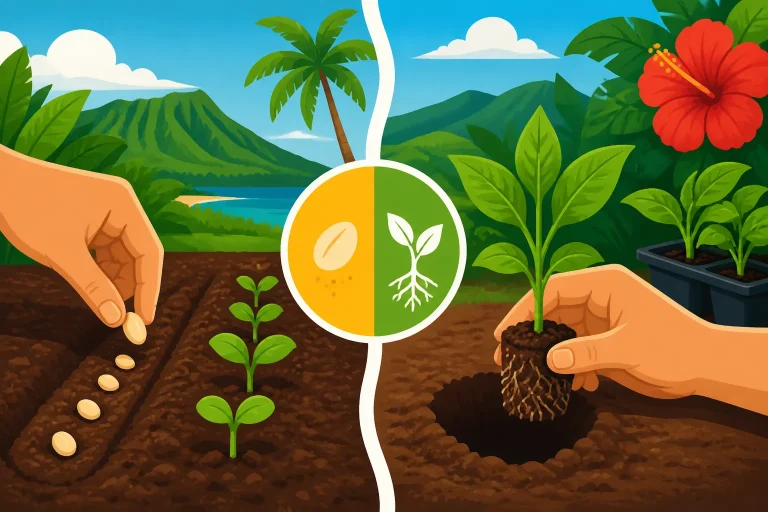
- Decide between seed and transplant. Direct-sowing and transplanting have different advantages, especially where heavy rain, wind, or strong sun can affect young plants. See Direct-Sowing vs Transplanting in Hawaiʻi Gardens.
- Prepare for the site’s main limitation. Improve drainage where beds stay wet, provide protection where wind damages plants, or use shade thoughtfully where intense sun stresses a crop.
- Adjust based on results. Keep notes on sowing dates, weather, germination, growth, and harvest. A few seasons of observations can reveal patterns that the zone label cannot.
A planting calendar should also be flexible. Weather does not follow a perfectly fixed schedule, and a week of rain or dry wind can matter more to a seedling than the zone assigned to its neighborhood. If a bed is saturated, sowing into it may lead to poor emergence or root problems. If seedlings are exposed to harsh sun and wind, they may need gradual adjustment before planting outdoors. The goal is to make the calendar fit the site, not force the site to match a generic date.
For ongoing vegetable planning, Month-by-Month Island Vegetable Sowing and Harvest Guide can help organize sowing and harvest decisions. A broad overview of suitable crops and garden care is available in Year-Round Island Vegetable Gardening: Sowing, Soil, and Care.
Perennials need a broader check
Zones are often most useful for perennial plants that remain in the ground for years, such as trees, shrubs, and some ornamentals. Even then, cold tolerance is only one part of selection. Check a plant’s mature size, light needs, moisture requirements, and suitability for the site. A plant that tolerates the lowest expected temperatures may still fail in poorly drained soil or under persistent wind.
For fruit trees, consider the conditions needed for flowering and fruiting, not just survival. Some fruiting plants need particular temperature patterns or growing conditions to produce reliably. A tree can remain alive yet produce little or no fruit if its needs are not met. For guidance focused on selecting fruit for local conditions, see Hawaiʻi Home Orchard Guide: Selecting Adapted Fruit Varieties.
A Practical Way to Choose Plants for Zones 12 and 13
When comparing plants for a Hawaiʻi yard, use a short decision process instead of treating the zone label as a final verdict.
First, check the plant’s stated hardiness range and what that information describes. If the range includes the map zone for the area, that is a useful sign for cold tolerance, but it does not prove the plant is suited to the site. If it does not include the zone, look for more specific guidance before buying, especially for an expensive or long-lived plant.
Next, compare the plant’s other requirements with the actual location. Ask whether the bed gets enough sun, whether it drains well, whether wind protection is needed, and whether the plant suits the local rainfall pattern. A plant with a suitable hardiness range can still be a poor choice if it needs conditions the yard does not provide.
Then consider the cost of a mismatch. For a short-lived vegetable, a small trial planting may be a reasonable way to test a crop. For a tree or shrub that will take years to establish, careful selection matters more. Start with a small number of plants if local performance is uncertain, and observe how they respond before expanding the planting.
Finally, keep the distinction between survival and productivity in mind. Hardiness information generally concerns whether a plant can survive cold conditions. It does not promise attractive growth, regular flowering, or a good harvest. Those outcomes depend on the plant’s full set of needs and the care it receives.
A useful field note can be simple: record the approximate elevation or site position, hours of sun, wind exposure, drainage after rain, planting date, and plant response. These observations will not replace the map, but they make future choices more precise. Over time, they help identify which parts of the yard behave like warm, sheltered pockets and which are more exposed or cool.
The most reliable approach is to combine three kinds of information: the USDA zone as a broad cold-tolerance reference, Hawaiʻi-specific planting guidance for seasonal timing, and direct observation of the neighborhood and garden. Zones 12 and 13 provide context. The yard itself determines how that context translates into a successful planting.
Frequently Asked Questions
Are USDA Zones 12 and 13 a planting calendar?
No. They describe average annual extreme minimum winter temperatures and are mainly useful for comparing cold tolerance. For sowing dates, use crop-specific guidance and account for local sun, rain, wind, and elevation.
Can one ZIP code have more than one garden climate?
Yes. A ZIP code can include different elevations, slopes, and exposures. Even within one neighborhood, shade, wind protection, and drainage can create noticeably different growing conditions.
Does a plant rated for Zone 13 automatically grow well in a Zone 12 garden?
No. A hardiness rating relates to cold tolerance, not overall suitability. Check the plant’s needs for light, heat, rainfall, drainage, and soil as well.
Should gardeners ignore zones in Hawaiʻi?
No. Zones can be useful when selecting perennials and assessing cold tolerance. The key is to use them as one reference point rather than as a complete description of a neighborhood or planting site.
Disclaimer
This article is for general informational purposes only and does not constitute professional advice. Laws, prices and regulations vary by location and change over time. Consult a qualified professional for guidance on your specific situation. Hawaii Gardening Guide is not a government agency and is not affiliated with any university extension, state department of agriculture or other government agency.