Direct-Sowing vs Transplanting in Hawaiʻi Gardens
Choosing between sowing seeds in a garden bed and planting seedlings can affect how reliably a crop gets started. In Hawaiʻi, rainfall, wind, sun, elevation, and soil drainage can vary sharply from one yard to another, so there is no single best method for every crop. This guide explains when each approach works, how to reduce common setbacks, and how to make the choice for your growing conditions.
What direct-sowing and transplanting mean
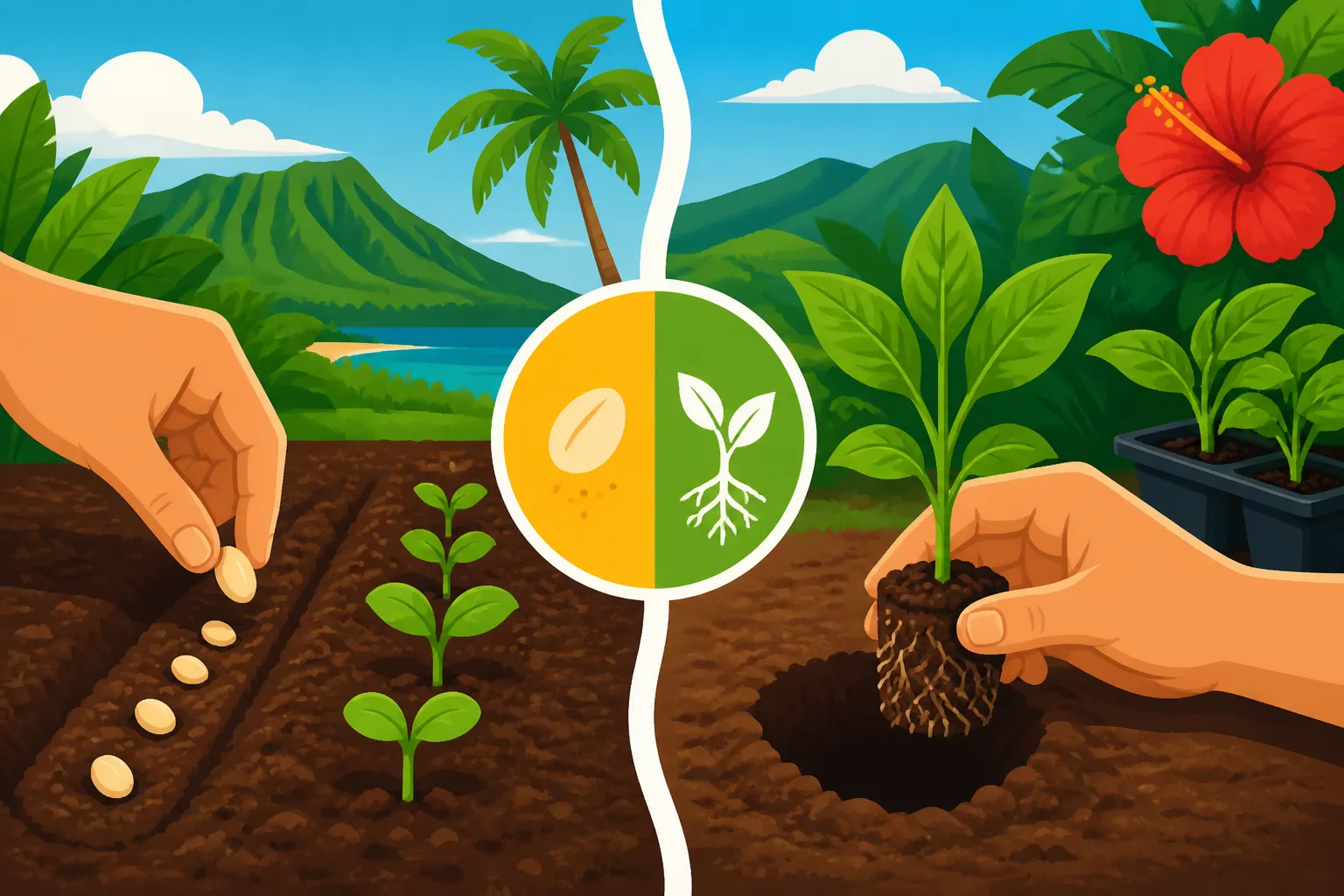
Direct-sowing means planting seeds where the crops will grow to harvest. You prepare the final bed or container, sow the seeds, and care for the plants in place. Transplanting means starting with a young plant that grew elsewhere, then moving it into its growing spot. The young plant may come from a nursery, or you may raise it in a tray or small pot before planting it out.
Neither method is automatically better. Direct-sowing avoids moving a young plant and works especially well for crops that dislike root disturbance. Transplanting lets you protect seedlings during their most vulnerable stage and gives you a head start on crops that take time to establish. The right choice depends on the crop, the planting site, and how much attention you can give it.
In Hawaiʻi, familiar mainland planting calendars can be misleading. Many gardens have a long growing season, but that does not mean every seed will thrive in every month. A low, sunny yard with fast-draining soil presents different challenges from a cool, wet upland bed or a windy coastal lanai. Use the calendar as a starting point and read your garden’s conditions. Hawaiʻi Home Garden Calendar: Sowing, Sun, and Seasonal Rains and Managing Wind, Sun, and Rain Across Island Microclimates offer more context for planning around local conditions.
| Consideration | Direct-sowing | Transplanting |
|---|---|---|
| Root disturbance | None, since the plant begins where it will grow | Roots are moved; some crops recover better than others |
| Early protection | Seeds and small seedlings are exposed in the bed | Seedlings can be protected before planting out |
| Bed preparation | The final growing space must be ready before sowing | Seedlings can be raised while the bed is prepared |
| Best fit | Root crops, many beans, corn, and other crops suited to in-place growth | Crops that benefit from a protected start, such as tomatoes and many brassicas |
| Main risk | Seeds may be washed away, eaten, dried out, or buried too deeply | Transplant shock from damaged roots, heat, wind, or abrupt changes |
| Ongoing attention | Keep the seedbed evenly moist and thin crowded seedlings | Acclimate plants, set them at a suitable depth, and water them in |
Think of the table as a first filter, not a fixed rule. A crop that is usually direct-sown may be started in a container when bed conditions are poor, while a crop commonly transplanted may also grow from seed in a suitable garden. Consider your space, available time, and the plants’ needs before choosing.
When direct-sowing is the better fit
Direct-sowing is a strong choice for crops that establish readily from seed and do not benefit much from being moved. It also avoids the extra steps of raising or buying seedlings. If your bed is ready, the weather is suitable for the crop, and you can keep the seedbed moist, sowing in place can be simple and reliable.
Crops that usually prefer an undisturbed start
Root crops are among the clearest candidates for direct-sowing. Carrots and beets form edible roots below the soil surface. Moving them after they begin growing can damage or distort those roots, so it is usually easier to sow them where they will mature. Radishes are another practical choice for direct sowing. Their quick growth makes them useful for filling small gaps, though crowded seedlings need thinning so roots have room to develop.
Beans are also commonly sown directly in the bed. Their seeds are relatively substantial, and seedlings can grow quickly when soil conditions are suitable. Corn is generally planted where it will grow rather than started in small containers, where roots can become crowded before the plants are ready to move. For more on these crops, see Direct-Sowing Beans and Root Crops Across Island Garden Beds and Direct-Sowing vs Transplanting in Hawaiʻi Gardens.
Cucumbers, squash, and melons can be sown in place where the bed has warm, well-drained soil and enough room. They can also be raised as young plants, but their roots are sensitive to rough handling. If you transplant them, use a container that allows a root ball to remain intact and avoid leaving the plants cramped for long.
These are common patterns, not rules for every variety or garden. Check the seed packet or reliable crop guidance for sowing depth, spacing, and preferred conditions. For crops with several possible starting methods, When to Direct-Sow or Transplant Crops Across Seasons provides a useful comparison.
Why in-place sowing can work well in island gardens
A seed sown in its final spot does not have to adjust to a different bed after it has begun growing. Its roots extend into the surrounding soil from the start, which can help it establish without the pause that sometimes follows transplanting. This is particularly helpful for crops that dislike root disturbance.
Direct-sowing can also reduce the work of maintaining seed trays. There is no need to monitor a separate nursery area, move seedlings in and out of shelter, or make a second planting session. For gardeners with limited indoor or sheltered space, that simplicity matters.
It can be a good fit for succession planting as well. Rather than sowing an entire row at once, plant a manageable section, then sow another section later if conditions and space allow. This can help spread out harvests of fast-growing crops. Staggering Vegetable Sowing for Continuous Island Harvests explains how repeated sowing can support a steadier supply.
Give a seedbed the right start
Seeds need more than a hole in the ground. The bed should have a fine, open surface where small seeds can make contact with soil without being buried under clumps or crust. Remove weeds and large debris, then loosen the surface without turning up more soil than necessary. If the bed drains poorly or stays saturated after rain, improve the growing space before sowing. Why High Rainfall and Water Tables Favor Raised Garden Beds discusses why raised beds can help in wetter sites.
Follow the seed packet for sowing depth and spacing. Seeds planted too deeply may not emerge; seeds left exposed may dry out or be displaced. Small seeds can be hard to space one by one, so sowing them thinly and thinning the emerging seedlings later is often more practical than trying to achieve perfect spacing at planting.
Keep the surface evenly moist while seeds germinate. A strong stream from a hose can uncover or wash away seeds, so use a gentle flow or a watering can with a fine rose. In a sunny, breezy spot, the surface can dry faster than expected. In a rainy or shaded bed, it may remain wet. Check the actual soil rather than relying on a fixed watering routine. For more on site-specific watering, see Adjusting Island Garden Watering for Wet Winters and Dry Summers.
Once seedlings emerge, thin them if the packet calls for it. Crowded seedlings compete for light, water, and root space. It can feel wasteful to remove healthy young plants, but leaving them all in place often produces weaker, crowded crops.
When transplanting gives seedlings an advantage
Transplanting is useful when a crop benefits from a protected start or when you want to use garden space efficiently. You can raise a small plant in a tray or pot while another crop is finishing, then move it into the bed when the space is free. A protected start can also reduce the time seedlings spend exposed to heavy rain, drying wind, intense sun, or animals.
Crops often started as seedlings
Tomatoes are commonly transplanted because young plants can be raised under closer care before they go into a garden bed or container. Many brassicas, including cabbage and broccoli, are also commonly started as seedlings. Young plants are easier to manage in a tray than tiny seeds scattered through a bed, especially when conditions make seedling emergence unreliable.
Lettuce and other leafy crops may be transplanted when a gardener wants a more orderly bed or needs to protect young plants during germination. Some varieties also grow well from direct-sowing. The decision can depend on the growing site and how closely you can monitor the seedbed.
Peppers and eggplant are often transplanted after being started in a protected place. A young plant can take time to reach a sturdy size, and raising it separately gives you more control during early growth. If starting these crops from seed, give them suitable warmth and light rather than assuming a shaded corner will be enough.
Transplanting does not guarantee a better result. A weak, root-bound, wilted, or poorly acclimated plant can struggle more than a seed sown directly in a prepared bed. Choose seedlings with healthy foliage and sturdy growth, and avoid planting them merely because they are available. Sourcing Garden Seeds and Vegetable Starts Across Hawaiʻi covers what to consider when choosing between seed and starts.
Raise seedlings with planting-out in mind
A seedling’s container is temporary, so the goal is to grow a healthy plant without letting it become crowded or stressed. Use a suitable seed-starting medium and containers with drainage. Keep the medium moist but not waterlogged, and provide enough light for compact growth. A plant that has stretched toward weak light may be harder to handle and establish.
Follow the seed packet or crop guidance for sowing depth and germination conditions. Avoid sowing too many seeds in a small tray if you cannot separate the seedlings without damaging their roots. When possible, sow into individual cells or pots so each young plant can be moved with its root ball largely intact.
Watch for signs that seedlings need attention: roots circling the bottom of a container, plants leaning or stretching, or leaves becoming pale or damaged. These signs do not always mean a seedling must be discarded, but they do indicate that it may need a more suitable space or better care before planting out.
If you buy starts, check that the plants are not badly wilted, crowded, or showing signs of pests or disease. A larger plant is not necessarily a better choice; a compact, healthy plant may adjust more readily than one that has spent too long in a small container. For seed-specific considerations, Checking Seed Germination Rates Before Planting Garden Beds can help you decide whether older seed is worth sowing.
Acclimate seedlings before moving them outdoors
A seedling raised under shelter may be adapted to gentler conditions than those in the garden. Moving it directly into strong sun, wind, or heavy rain can cause stress, even if the bed is otherwise suitable. Acclimating, or hardening off, means gradually exposing a seedling to the conditions it will face after planting.
Start by giving seedlings short periods in a sheltered outdoor spot, then increase their exposure as they adjust. Protect them from harsh midday sun, drying wind, and pounding rain during this transition. The process may take different amounts of time depending on the plant and the contrast between its starting place and the garden. Watch the leaves and soil, rather than following a rigid schedule.
A few days of gradual adjustment can prevent the abrupt change that makes leaves wilt or scorch. If the weather turns harsh, provide temporary shelter or pause the transition. Hardening Off and Transplanting Vegetable Seedlings Outdoors gives more detail on this step.
How to choose for your yard and crop
The choice is not just “seed or start.” It is a decision about how a crop will handle your specific planting conditions. Before sowing or transplanting, consider what the crop needs at its earliest stage and what your garden can provide.
Start with the planting site
Check the bed’s exposure to sun and wind. A seedbed on a windy edge may dry out quickly or lose small seeds during watering. A sheltered area may retain moisture longer, particularly after rain. If young plants are exposed to strong afternoon sun, they may need a gentler start or temporary shade while they establish.
Drainage matters in both methods. Seedlings and seeds can both fail when soil stays saturated, while fast-draining beds may dry before seeds germinate. Observe the site after rain and between watering. If puddles remain or the soil is persistently wet, adjust the bed before planting. In a quick-draining area, use a watering method that moistens the root zone without washing soil away.
Elevation can change temperatures and growing conditions, but the address alone does not tell you exactly how a bed will behave. Nearby walls, trees, slope, and exposure all matter. Upland and Lowland Planting Windows Across the Islands and Mapping Microclimates Across Hawaiian Neighborhoods can help put local variation in context.
Consider your time and equipment
Direct-sowing asks you to care for the seedbed until seedlings are established. You need to water gently, monitor germination, and thin plants when necessary. If you are often away or the bed is difficult to check, the exposed early stage may be a drawback.
Transplanting requires a different set of tasks. Seedlings need suitable light, moisture, and containers before they reach the garden. They also need acclimation and careful planting. Buying starts can save the work of raising them, but it does not remove the need to check plant health or help them adjust after planting.
Container gardeners may use either method. Direct-sow crops with larger seeds into their final containers when there is room for them to mature. A transplant can be useful for a crop that needs a more controlled start, but the container must be large enough for the plant’s roots and mature growth. In either case, pay attention to drainage and how quickly the potting mix dries. Trellised and Container Crops for Small Island Spaces offers ideas for making limited space work.
Match the method to the crop, not just the calendar
A month on a planting chart cannot account for every garden’s sun, rainfall, and shelter. If a seed packet recommends sowing under particular conditions, use that guidance as a starting point and compare it with the conditions where you plan to plant. If the bed is too wet, too exposed, or not prepared, waiting or starting seedlings in a more suitable spot may be wiser than sowing immediately.
Likewise, a seedling that is ready to plant out still needs conditions it can tolerate. If the bed is waterlogged, exposed to strong weather, or not yet prepared, keep the seedling in a suitable container and wait for a more favorable opportunity. Avoid holding it in a small pot for so long that the roots become crowded.
A practical rule of thumb is to direct-sow crops whose roots are sensitive to disturbance or that establish readily in place. Consider transplanting crops that benefit from a protected start, take longer to become established, or are easier to manage as young plants. Then adjust for the variety and your yard. The broader planning approach in Direct-Sowing vs Transplanting in Hawaiʻi Gardens can be paired with Hawaiʻi Home Planting Guide: Seeds, Starters, and Sun Exposure when you are deciding where and how to begin.
Botanical Interests seed packets can be one source of crop-specific directions when you are selecting seeds. Whatever the seed source, check the packet for details such as sowing depth, spacing, and germination conditions, then adapt your plan to the bed rather than treating general instructions as a substitute for local observation.
A simple process for making the choice
Use this sequence before you plant. It works for both garden beds and containers, and it helps prevent rushing a crop into conditions that do not suit it.
-
Identify the crop and variety. Check whether the crop is commonly direct-sown, transplanted, or grown either way. Read the packet or other reliable crop guidance for its particular needs.
-
Check the site. Look at sun, wind, drainage, and the amount of space available. Consider how quickly the soil or container mix dries and whether heavy rain reaches the spot.
-
Decide what you can manage. If you can keep a seedbed moist and protect emerging seedlings, direct-sowing may be straightforward. If you can raise or care for starts and acclimate them, transplanting may give you more control.
-
Prepare the growing space first. Clear weeds, loosen or improve the bed as needed, and make sure containers have drainage. Do not sow seeds into soil that is compacted or persistently waterlogged.
-
Plant carefully. Follow the crop’s recommended depth and spacing. Water gently so seeds stay in place. For seedlings, keep the root ball intact as much as possible and avoid burying the stem unless crop guidance supports that method.
-
Watch the plants and adjust. Check moisture, look for emerging seedlings or transplant stress, and respond to the actual weather. Thin direct-sown seedlings when needed, and give transplants suitable care as they settle.
Keeping brief notes can make future choices easier. Record where you planted, which method you used, and what happened after rain or a dry spell. Over time, those observations can be more useful than a calendar that ignores the differences between your beds.
Frequently Asked Questions
Can I direct-sow every vegetable in Hawaiʻi?
No. Many vegetables can be grown from seed, but some crops are easier to manage as transplants, while others are more sensitive to root disturbance and are often best sown in place. Check the needs of the crop and variety, then account for your garden’s conditions.
Is transplanting always faster?
Not necessarily. A transplant is already a young plant, but it may pause while adapting to a new bed. A directly sown seedling avoids that move, though it has to germinate and grow from the beginning. Which method reaches harvest sooner depends on the crop, the plant’s condition, and the growing environment.
Can I start a crop in a pot and transplant it later?
Often, yes, but use a suitable container and move the plant before its roots become badly crowded. Some crops tolerate transplanting better than others. Handle the root ball carefully and acclimate the seedling before planting it outdoors.
What should I do if rain keeps washing seeds out?
First check whether the bed drains well and whether the seeds are being planted at the recommended depth. Water gently when you need to supplement rainfall. If the site is repeatedly saturated or exposed to runoff, consider a more protected planting spot or a raised bed. Do not assume that adding more water will help a seedbed that is already too wet.
Disclaimer
This article is for general informational purposes only and does not constitute professional advice. Laws, prices and regulations vary by location and change over time. Consult a qualified professional for guidance on your specific situation. Hawaii Gardening Guide is not a government agency and is not affiliated with any university extension, state department of agriculture or other government agency.